_edited.png)
Empowering Elementary Students: 3 Effective Strategies to Combat Anxiety
- Erin Mckenzie

- Jul 20, 2025
- 10 min read

Note: Some of the links in this post are affiliate links. This means that I am a participant in the Amazon Services LLC Associates Program, an affiliate advertising program designed to provide a means for sites to earn advertising fees by advertising and linking to amazon.com. Read my full disclosure here.
My body is trembling so much that I feel the bed shaking. Deep breath…if I picture the word “No” three times…no three sets of three to equal nine times, I won’t throw up. I perform my ritual, I see the word “no”, I think I’ll be okay. Nope, I need to do it again, still trembling. With a deep breath in and out, my body calms, for a moment. Then the trembling begins again.
Did I check the oven? I did, but what if I didn’t do it right?
I slink out of bed and ever so silently begin my long trek down the splintery wooden hallway. The floor betrays me with a creak and I freeze, barely breathing. I hear the faint sound of the tv and the familiar pattern of snoring coming from the living room. I can picture my dad reclined back in his favorite armchair while my mom struggles to hear the crazy antics of Carol Burnett coming from the small black & white tv. The chair my mom sits in has a direct view to the kitchen. I continue my journey down the hall and cross the threshold to the yellow linoleum. I breathe a sigh of relief as I exit the creaky floor of the hallway and know I’m nearing my destination. Six more steps, I’m almost there. As I approach the corner, I know I need to move ever so carefully. I take another deep breath and swiftly rotate my body counter-clockwise to face the oven. I’m scared to look to my left to see if I succeeded unnoticed. I stand still and wait for the familiar phrase from my mom,
“Erin! What are you doing out of bed again!?”
What would I even say?
I have superpowers!
It's true, but she wouldn't believe me.
I'm trying to save you all!
Again true, but she would say I’m being ridiculous.
If you interrupt my routine, I’ll have to start all over again!
Start what over? Ugghhh, that’s just too much to explain and she wouldn’t get it.
I had to go to the bathroom and then heard the tv and wanted to see what you were watching.
Okay, she’ll be mad, but that could work. I have a plan.
I slowly turn my head to see exactly what I had imagined. My dad sacked out in the chair and my mom focused on her show. So far, so good. I move my hand ever so slowly to rest it on the main dial of the oven. I can’t see it, but I know how it feels when it’s off. It is off. I lift my hand to the oven dial 9 more times, but in sets of 3. On my second set of three, I touch the dial the wrong way. Worry sets in, but I can fix this, I just need to start over. After 4 tries, I get it right, but I can’t stop on 4, that’s my bad luck number. Just one more try, I got this…focus and move ever so carefully. Done. I can retreat to my bedroom. I wonder what time it is now?
The thought of going back to my bedroom is tiring. I know how to do it, but now I have to deal with checking on my little brother again to make sure he’s breathing, crossing the threshold 9 times, turning my light switch on and off 9 times, looking under my bed 9 times, kissing my 24 stuffed animals 9 times, crawling under my covers and visualizing the word “no” 9 times…all in sets of 3 and all so that I don’t throw up and so that my family is saved from anything bad.
That was my story. I struggled with OCD and emetophobia (an intense and irrational fear of vomiting or witnessing it) as a child. It was in the '80s when mental health issues were rarely discussed. With the OCD, I truly believed that I was burdened with superpowers.
Emetophobia wasn’t even a recognized diagnosis back in the 80’s, but it was definitely a diagnosis for me. I avoided any experience that could expose me to witnessing vomit. I refused to watch movies that I hadn’t seen before unless they were approved by my family members, I wouldn’t go to amusement parks, I would cover my eyes when passing pulled over cars on the side of the road, and I never, ever ordered chicken at a restaurant for fear of it being undercooked.
Much to my pleasure and comfort, people enabled me by accommodating my anxiety. My college roommates would turn on the bathtub to cover the noise when they were managing their hangovers. My family members would warn me if I needed to look away or cover my ears during a movie. Now there are even websites for emetophobia movie warnings.
Websites enabling my anxiety.
Even though I had a team of people who continued to accommodate my anxiety, accidental exposure was inevitable. These incidents of exposure have played a big role in my recovery of this phobia. I’m not there yet…habit has forced me to throw my hands over my ears or flee, but if it does happen, I am okay. I can still eat, I can still fall asleep, I no longer experience panic attacks, and I’m no longer willing to lose my job by fleeing from a classroom (well, I can’t make any promises).
If I wanted to extinguish this fear, I could intentionally expose myself to more experiences relating to vomit.
But I don’t wanna.
People have accommodated my anxiety and as a School Counselor, I have accommodated the anxiety of students. I find it difficult to provide "tough love" because, like other school staff, I've been trained to show empathy, kindness, and support. Unfortunately when it comes to anxiety, we sometimes overdo it and end up making it worse in the long run. Without realizing it, instead of helping to combat anxiety, we enable it.
Lynn Lyons, co-author of “Anxious Kids, Anxious Parents” and “Playing with Anxiety: Casey’s Guide for Teens and Kids” and the author of “The Anxiety Audit: Seven Sneaky Ways Anxiety Takes Hold and How to Escape Them (Anxiety Series)”, teaches people to understand how worry works and how to have a different response to it. She stresses the importance of teaching kids how worry works in the brain and body. She also encourages kids to give their worry a name and then teaches them how to talk to it in a way that is productive.
Sounds simple enough, right?
Well, it’s not…but with consistency, it’s very possible to support students to work through their anxiety, rather than allow them to avoid or control it. Sometimes we need to do what’s hard, not what feels good at the moment.
Let's stop enabling and instead discover how to combat anxiety, using 3 strategies...
Strategy #1 Encourage children to accept and manage discomfort and uncertainty in unforeseen situations.
Doesn’t sound very appealing does it? If you weren’t sure what it meant to “combat anxiety", this is it. It definitely wasn’t something I wanted to grab by the horns when I was waist deep in vomit avoidance and saving my family by repeatedly touching light switches. If I only knew that avoidance actually strengthened my worry. If I only had someone to coach me to face those uncomfortable feelings and then be there to support me when I was figuring out that I would be okay.
“Being uncomfortable and uncertain is the price you pay for moving into new territory, and in order to grow you need to move into new territory. (Worry says STOP. Worry is not a big fan of moving forward).” (Wilson & Lyons, 2014, p. 74).
Have you ever noticed that a worried child will ask lots of questions? Or the same question over and over, even if you just answered it 30 seconds ago?
This is because worry likes certainty & predictability. Life is uncertain and unpredictable, so our job as adults is to allow kids to feel uncertain and discover that they will be okay. Give them permission to not have to know everything that could happen. The more times we answer their repetitive questions, the more they will ask them because they are looking for us to provide certainty and we continue to try.
Now…here’s the hard part. When you change how you answer their worried questions, their anxiety will get bigger at first and their questions might come faster. If you are able to be consistent, then eventually they’ll learn that they can’t know everything all the time.
As a teacher, school counselor, or better yet a PARENT, I promise, this will make YOU feel uncomfortable, but it’s absolutely necessary for recovery and here’s why:
When we try to provide certainty by always answering the questions, it creates an unhealthy behavioral pattern, a dependence on adults for answers and a lack of confidence in themselves to handle the strong feelings. This is a band aid that can increase worry in the long run.
Here’s HOW to redirect:
Many questions that anxious children ask are those we cannot answer or are beyond our control (ie: weather, a kid becoming sick, fear of something bad happening, etc). You could say:
I don’t know the answer, but it sounds like your worry is taking over.
It’s okay to feel unsure and uncomfortable, you’ve done harder things.
That’s your worry talking and we’re not putting your worry in charge.
Child: Am I gonna throw up??? (panicked, breathing fast, crying hysterically)
Me: Maybe, but you can handle it if you do. (boring, non-emotional)
Child: Am I gonna be okay??? (still panicked, breathing fast, crying hysterically)
Me: I’m pretty sure you've done harder things. (still boring, non-emotional)
Child: I’m scared! I think I’m gonna throw up! Am I gonna throw up? (more panicked, breathing fast, crying hysterically)
Me: It’s scary not knowing (in my mind…please don’t) but it sounds like your worry is in charge here. (still boring, non-emotional and potentially masking my own panic while getting ready to flee the area)
Wow, sounds cold, shouldn’t you help her calm down? Isn’t this going to cause MORE panic for the poor kid?
Absolutely! At first, but you gotta remember that we are trying to combat anxiety, NOT the child.
She’s used to people telling her that she’s not going to throw up or that she’s just fine. We don’t know this! Helping someone manage anxiety means allowing them to be okay with the unexpected.
On a scale of 1-5, she’s at a 5. At this point it’s too late to calm her down.
When experiencing intense emotions such as anger or anxiety, it's most effective to address them early, at a level 2 or 3, and apply the mindfulness techniques we practice weekly in guidance class as a preventative approach. If she gets to a 5, chances are, those strategies will not work and she will lose faith in them.
Let’s use mindfulness to recognize how our body is feeling at various moments throughout the day and notice what happens inside when worry starts to set in.
We should also cultivate mindfulness as a habit by practicing techniques when calm, allowing engagement of the prefrontal cortex, rather than waiting until the amygdala is in control.

Strategy #2 Teach kids how worry works in the brain and body.
When children understand WHY their bodies react the way they do when panic sets in, it becomes far less frightening! Imagine being a child and suddenly experiencing a stomach ache, tingling sensations, shakiness, rapid breathing, and a pounding heart without understanding the reason. This lack of understanding can heighten anxiety, leading to more intense physical reactions and possibly a panic attack. By learning about this cycle, children can gradually find it less intimidating and more manageable.
Mineola Grows released excellent videos that educate elementary students about their brain. The Self-Regulation Series includes videos about the brain that my 1st through 4th graders absolutely LOVE. They request to watch them repeatedly!
I've created a companion lesson for these videos titled: Worry & The Brain. This lesson is most effective when implemented after watching the videos.
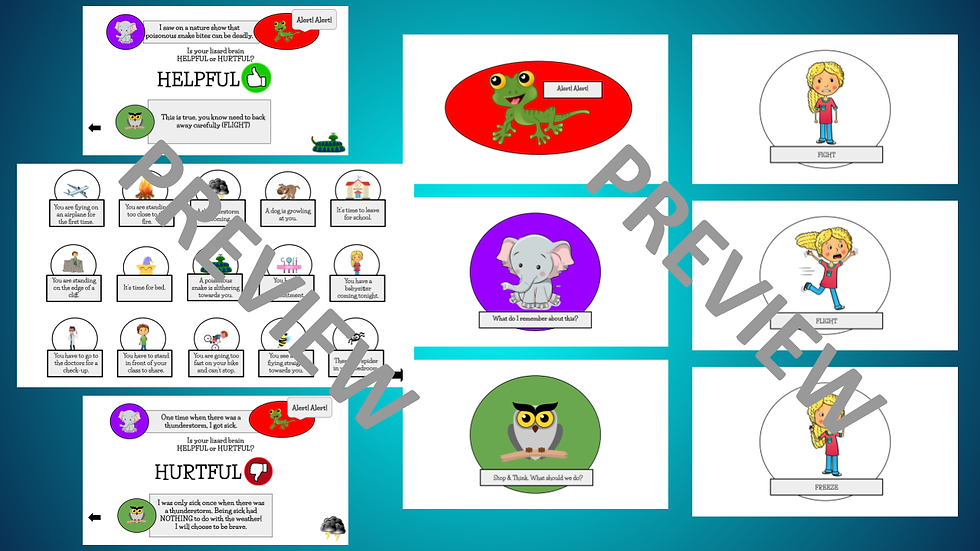
Strategy #3 Teach kids to externalize their worry by using these methods...
When kids know how to externalize their worry, they are able to separate the feeling from themselves and treat it as a separate character that they can then speak to in a way that is helpful and productive.
In Playing with Anxiety, Wilson and Lyons explain three things to know about worry and then what to do about it.
First, We must expect worry to show up, because it will, time and time again. Everyone has worried thoughts!
“Oh, hi, worry. It’s you again. I was thinking you might show up. I know you’re just trying to help.” (Wilson & Lyons, 2014, p. 71).
Second, Take Care of the Worry…Acknowledge it and then take care of it.
“I'm going to feel nervous, and then it’ll be over. It’s OK; things will work out. It’s OK. I can handle whatever happens. I’m safe, even though I feel scared.” (Wilson & Lyons, 2014, p. 71).
Third, Boss That Worry Around…YOU are in charge, not your worry!
This is hard for kids to remember in the thick of it. You can be their coach and remind them how to talk to themselves when it shows its ugly face.
“You’re not helping. I’m going to ignore you. I know you’re there, but I’m busy. Knock it off! Stop trying to scare me! You’re ruining my fun. I’ve had it with you. ” (Wilson & Lyons, 2014, p. 71).

This sounds like a lot of information to put into practice, but having a plan in place and educating other staff members is key! If your worried student has a 504 plan in place for anxiety, make sure that it’s not accommodating the anxiety. Click HERE for a free sample 504 plan for students with anxiety.
The accommodations in this plan aim to foster student growth, not increase anxiety.
Stay tuned for additional tools designed to assist children in managing their anxiety productively!
Resources:
Wilson, Robert R., and Lynn Lyons. Playing with Anxiety: Casey’s Guide for Teens & Kids. Pathway Systems, 2014.


Comments